
Inside: Our own experiences with the first stage of the milk ladder.
My youngest daughter was born with a cow’s milk allergy. Not that we knew it at the time – I just began life with a newborn as any mum would.
For the first 2 weeks of her life all was well besides a complete inability to latch on, which we would later discover was down to tongue-tie. But it then became very obvious (due to my previous experience of my first child having lactose intolerance) that someone wasn’t right.
She was screaming in pain about 20 minutes after a feed (delayed reactions are common) and would develop mild hives all over her body. The doctors didn’t have a clue and because they weren’t instant or severe reactions, they brushed it off as nothing.
But I knew and persisted until someone listened to me.
Of course, if you are dealing with a severe allergic reaction then head to A&E where a health professional will be able to give you immediate help.
Did you miss part 1? Or want to see the whole series?


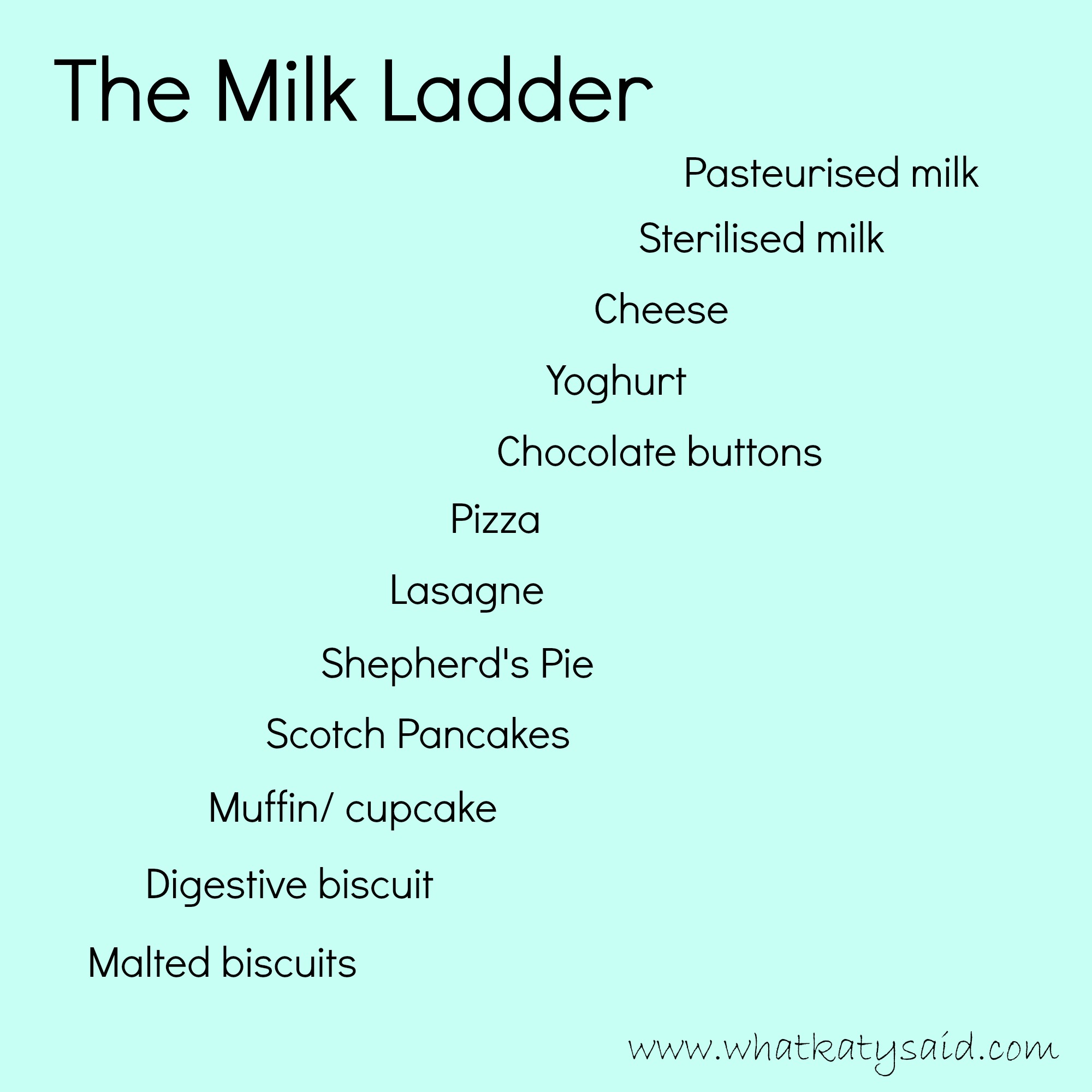
If you have been following the series, you will know that we started my daughter on the milk ladder challenge and she successfully completed the first step: malted biscuits. You can find my malted milk biscuit recipe here.
Click here for all of the recipes in my milk ladder series.
Stage 2 of the Milk Ladder – Digestive Biscuits
Stage 2 is not dissimilar to stage one in that it is a biscuit but instead of using malted milk as the ingredient it uses dried skimmed milk powder. Unlike stage 1, where we had to make our own biscuits, this stage can use store-bought biscuits.
TIP: When shopping for Digestives, be sure to check the ingredients. Top brands seem to be dairy-free now, so you might have more luck with shop-own variations.
How did she get on?
We started off with a pea-sized piece of digestive and each day doubled the amount until she was eating a whole biscuit. Starting with small amounts ensures you don’t overload the immune system and increases the chance of success.
She didn’t even have a mild reaction, with no gastrointestinal symptoms or rashes on her skin, which I was so relieved about. I was always paranoid that we were going to have a night from hell but she was always fine thank goodness. This then meant I could move her on to stage 3 which is muffins/cupcakes.
Success!!
Stage 3 of the Milk Ladder – Muffins
The next step on the ladder is muffins/ cupcakes but this time you will need to make these yourself to make sure they have the exact amount of dairy products needed.
Here is the recipe for 8 muffins:
Ingredients
132g flour
40g cocoa powder
1 1/2 teaspoons bicarbonate of soda
100g soft brown sugar
40ml oil (any)
70ml apple puree
200ml milk
1/2 teaspoon vanilla extract
Method
It’s a simple one! Hurrah!
– Mix all of the dry ingredients in one bowl: flour, cocoa powder, sugar and bicarb.
– Mix all of the wet ingredients in another bowl: oil, apple puree, milk and vanilla.
– Combine the two mixtures together, put a big dollop in each muffin case and bake for 20 mins at 180ºC. The mixture is quite runny but they do rise nicely.
How did she get on?
She had no reaction to the cakes, even eating a whole one near the end of the day (I always try to give new things in the morning so any possible reactions happen before bedtime). I couldn’t believe she had something containing milk – I’d felt so nervous adding it into the mixture!
Success!!
This marked the end of the baked milk challenge for us – moving on to ‘cooked milk’ and more obvious forms of milk as we continue up the ladder.
Stage 4 of the Milk Ladder – Scotch Pancakes
We are now at the scotch pancake stage – not the most common foods you’d think of but obviously a necessary rung of the ladder as the milk is pan-fried within the mixture.
We started with half a pancake, probably the size of her hand, just to be sure to take it slowly. Then increased by a half each day until she was happily eating 2 pancakes for breakfast.
We bought shop ones but here is the recipe to make 18 pancakes:
Ingredients
120g self-raising flour
pinch of salt
30g caster sugar
1 egg
144ml milk
Method
– Sift the flour and add the salt into a bowl.
– Crack the egg into the milk and whisk together in a jug.
– Combine the wet and dry ingredients into the jug so that you can pour the mix into the pan.
– Heat the pan and test it is hot enough by placing a small bit of batter to check. When the surface of the batter is covered in bubbles it is time to flip the pancake.
How did she get on?
Once again she had no issues. The fact that the milk was pan-fried rather than baked had made me nervous but she aced it!
Success!!
Head over to part 3 of our milk ladder journey >>>


Swapna D
Tuesday 31st of March 2026
What do I substitute for sugar? My baby is just 11 months old and I am avoiding sugar for a few more months.
Katy
Wednesday 1st of April 2026
Honey is a good natural substitute. x
Hayles
Monday 10th of March 2025
Hi Katy, thank you so much for this series - I have found it so helpful! We are now on the pancakes stage but my son is allergic to egg, can you make these pancakes without egg? Thank you x
Katy
Tuesday 11th of March 2025
Oh the poor thing! I have no experience with egg allergies but I do know that you can substitute eggs for mashed up banana instead (around half a banana for each egg substituted). The flavour might be a bit weird though so another alternative is applesauce - apparently that works really well. Around 1/4 measuring cup would probably do but add slowly until you get the desired consistency. x
Svitlana
Sunday 19th of February 2023
Hi Katy! Thanks a lot for your help with this! Please advise how long/how many days a kid should be fed on stage 4 and further? I mean if it's a pancake than seams ok to cook it 9 days in a row increasing an amount every day, but how it should be with pie, lasagne, pizza? Thanks in advance!
Katy
Thursday 23rd of February 2023
Hiya! So the recommended amount is 3 days before moving on. But I was always extra cautious so I'd do 3 days and then give it a rest for a bit (also so they didn't get bored) and then would do another few days - just to be sure. There is absolutely no reason why you couldn't just stay at a particular stage for a few weeks, having usual food in between sporadic tries of the pizza or whatever. And then when you feel ready, move on to the next stage. x
Michelle Bakuska
Tuesday 13th of April 2021
How old was your little one when you started introducing the milk ladder?
Rebecca Jeffery
Sunday 18th of August 2019
Hello, I have a question. My son has a milk intolerance. He is being perscribed similac. We have started weaning, I mix his special formula with baby rice (baby porridge has milk in it). When making muffins ect do I use normal cows milk?, apatimel formula? Or his own perscribed formula?
I really don't want him getting tummy pains or blood in his poo again!
One anxious and nervous mummy!
Katy
Sunday 18th of August 2019
Hi Rebecca! It is so hard isn’t it? It is up to you if you want to stick with his Sumilac but I personally would use oat milk seeing as he will still be having bottles at this stage to get the nutrients. But definitely don’t use cow or normal formula as it will trigger symptoms. Once he reaches one year old you can move him off formula and on to oat milk in his bottles and once you feel he is ready (between 2 & 3 years old) try and get him up the milk ladder. Always here if you need more advice xxx