
Inside: How to plan for the school holiday plus a free summer holiday planner.
The school holidays can be daunting, can’t it? What are you going to do to keep the kids entertained and happy for all of those weeks? If budget allows or for childcare reasons, many families sign their kids up for various clubs and camps but that option isn’t available for everyone. If, like me, you have neither the funds or need to send the kids off each day, you need to work out a plan of action.
Using a visual planner can help you to get organised; getting activities booked in and buying any necessary materials needed. It also helps you to feel less overwhelmed if you struggle with the kids being home for extended periods as you know exactly what you’re doing and when.
Another bonus reason for using holiday planners is that when the holiday comes to an end, you are more able to look back and remember all of the things that you did – even if you didn’t end up doing everything you planned. We’ve been doing it for years and we enjoy the holidays each and every time!
What is a school holiday planner?
You can create your planner in whichever way works best for you and your family, but in essence it is a calendar that is devoted entirely to the activities you have planned for the time they aren’t in school. You can put one together for the shorter breaks as well as the longer breaks, or just use it for the extended school break between school years – whatever works for you.
We tend to make loose plans for the half terms, Christmas and spring break, only using the holiday planner for the long 6 weeks holiday in the summer as there is just so much time to fill.

The planner is divided up into rows for the weeks and then broken down further into days, with each day having a space for you to make your various plans. Depending on the age of your children you may want to do digital copies, small paper copies or go big with a colourful display.
Our planner is on a massive A1 sized piece of card and uses colourful post-it notes for each daily activity. I made it big when the kids were small so it was nice and clear, and now it has become a tradition to get it out each summer and plan out everything we want to do together.
How to plan the school holidays
Here is the process I use each and every year to get myself organised and prepared for the holidays. Some years we’ve done it a few weeks before but other times we have done it at the beginning of the holidays, on day 1 as an activity in itself as a fun way to start off our time together.

Check your diary
The first thing to do is to check your diary / calendar to see if there are any immovable events booked in. You might have a family vacation booked or holiday programs / clubs scheduled for certain days – add them onto the planner first so you know the days you have available to you.
Check local activities
Does your local area put on any events each year? Keep an eye out for free activities or cheap days out – local Facebook groups will often share activities that you can sign up for.
Our local library runs a free Summer Reading Challenge each year where you get a medal at the end of the holiday if you’ve read 6 or more books. The kids absolutely love it and it means we can write down ‘visit the library’ every week or two.
Make a list
Sit down with the kids and ask them what they would like to do. You’ll probably be surprised with their answers as they won’t be as extravagant as you’d imagine. Mine often request pillow fights and movie marathons and I have to try and prompt them to think of more exciting things like days at the beach etc…!
A great way to get them started is to reflect on past holidays, thinking about activities they’ve tried and enjoyed before. What happy memories do they have that could be recreated? Have their friends told them about something they have planned that they wish they could do too?
Write everything down, all ideas are great ideas. If you’re stuck, there is a list of ideas further down to get you started.
Fill in your planner
Your planner may already have some spaces filled in if you have some plans already but now it is time to fill in the rest of the space.
Work through the list you made and allocate each item to a day on the planner. Even if the activity is something small like “pillow fight” it gets its own space. Because the thing is, this plan isn’t about filling up every single minute of every single day. It is about making sure that you do everything you want to do, so that when you get to the end of the holidays you can look back and say “wow, we had the best time!”.
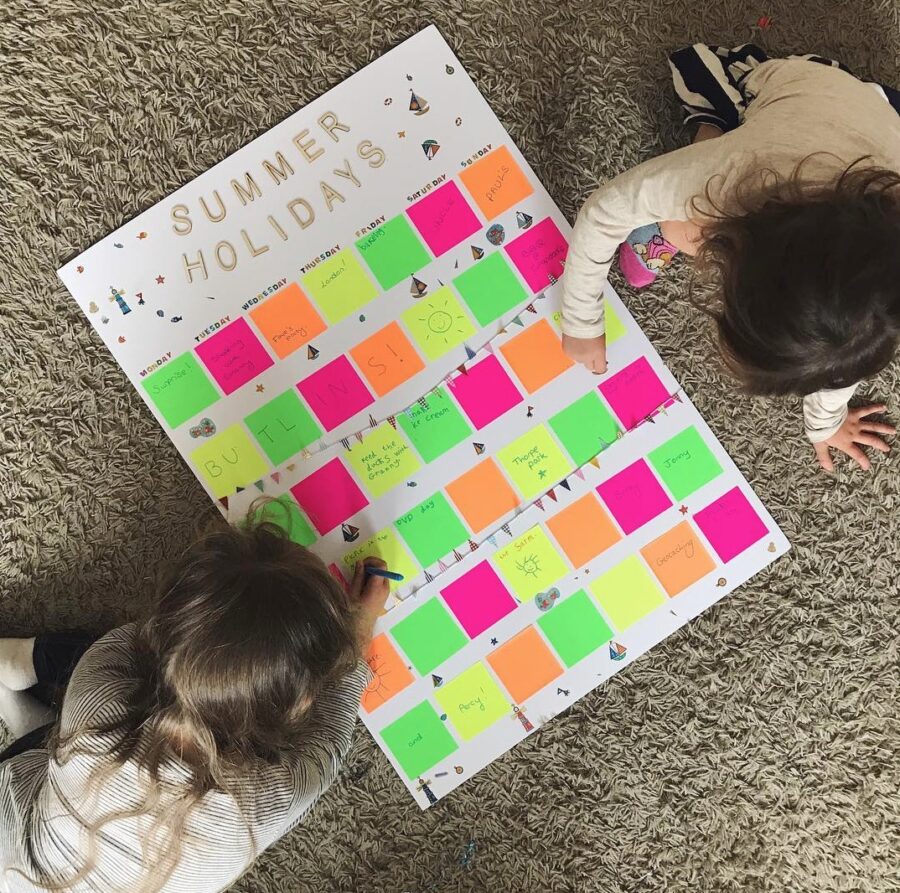
So yes, a pillow fight might only take 10 minutes of that day, but it ticks it off the list. The rest of that day may be spent playing in the garden or them playing independently – not everything has to be planned out and ‘busy’.
When you are adding things onto the planner, try and space out any bigger activities like “go to the zoo” or “go to the seaside” so that you do one a week rather than two days in a row. You don’t want to have a super busy schedule one week, followed by a quiet week – much better to spread it all out.
Something to note: Plans change and activities can be flexible so don’t worry too much about making it perfect.
How to make a school holiday planner

I have created a free printable planner for you to use if you simply want to stick something up on the fridge or noticeboard. What I would recommend though is using a pencil or an erasable pen to fill in each day’s activity so that you can move things around when plans (inevitably) change.
If you fancy making a large planner like the one we use, this is what you will need:
- A1 board
- Craft glue
- Decorations (stickers etc)
- Sticky notes
It is entirely up to you how you put it all together but the main thing to allow for is the number of rows – with one row being one week of the holiday.
Lay out the sticky notes in rows and columns so that you can see how much space is left available, then use your stickers and decorations to personalise it.
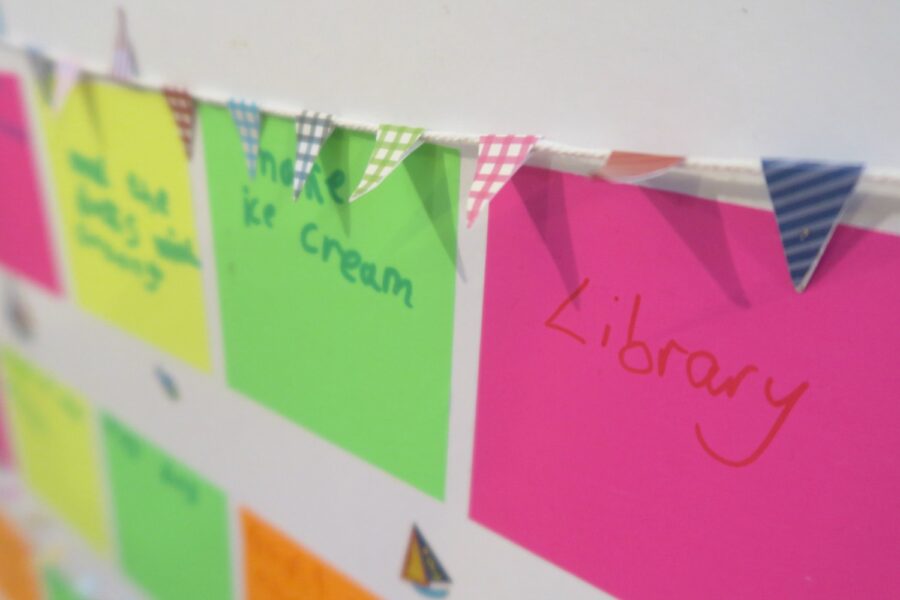
We used wooden letters to write the title, miniature bunting to divide up the rows and plenty of sparkly stickers to make it look fancy. The kids had a blast making it!
The reason we use sticky notes for teach day is so that we can move them around as and when we need. If we fancy making a cake instead of the planned activity of “playing board games” we can swap them over to suit our mood.
The ones we use are actually not sticky, but use static to attach themselves to the board – no flapping around and they never lose their ‘stick’. Grab some static notes from Amazon or The Range.
School holiday activities
If you are stuck for ideas, here is a list of activities we have done in the past:
Younger kids
Build a blanket fort
Build sandcastles
Bake cakes
Play hide n seek
Have a bedtime disco
Make storytelling baskets
Blow bubbles – easy bubble mix recipe
Older kids
Go on a bike ride
Camp out under the stars
Go geocaching
Make ice cream
Make pizza
Play board games
Have a sleepover downstairs
Do some plane spotting – this is the app we use
Have a pillow fight
All ages
Have a picnic
Listen to audio books together
Visit family members
Go on spur-of-the-moment road trips
Go on a treasure hunt
Play in the water sprinkler
Plant flowers
Have a BBQ
Have a family movie night
Paint rocks and hide them for others to find
Go to the splash park
Join a summer reading challenge
What makes a fun school holiday?
The thing to remember is that kids don’t need expensive holidays, they are happy wherever they are as long as they are spending quality time with you. They don’t need every second planned out for them, they just need a few fun things to do, life experiences that become great memories from their childhood.
The most important thing though is that it is important for kids to have down time, to unwind and relax after a busy time in school. They spend so much time being told what to do on a school day that when faced with nothing to do in the holidays, they announce they are bored.
But you know what? It is good to be bored. Boredom teaches kids to search inside their minds for something to do, helping them develop their imaginations and independence.
If we plan out every single minute for them, they’ll never learn to relax, let go and be happy in their own company. So don’t worry about always entertaining them, the only way they’ll manage it on their own is if you let them.
I hope this has been useful. Hopefully, at the end of the holidays you will look back and feel as though you did everything you set out to do and that your children will head into the start of a new school term or new school year filled with happy memories of time well spent.