
Inside: Talk to Your House: Practicing English with AI in Your Living Space. Collaborative post.
I. Introduction to AI in Daily Life
In the past several years, artificial intelligence (AI) has increasingly become an ordinary part of our daily existence, seamlessly integrating itself into the fabric of our homes. From voice-activated smart speakers to smart home appliances that can learn our preferences, AI technology is revolutionizing the way we interact with our homes.
This is not merely about convenience; it offers new ways to make our lives more engaging and enhance our abilities, like learning a new language.

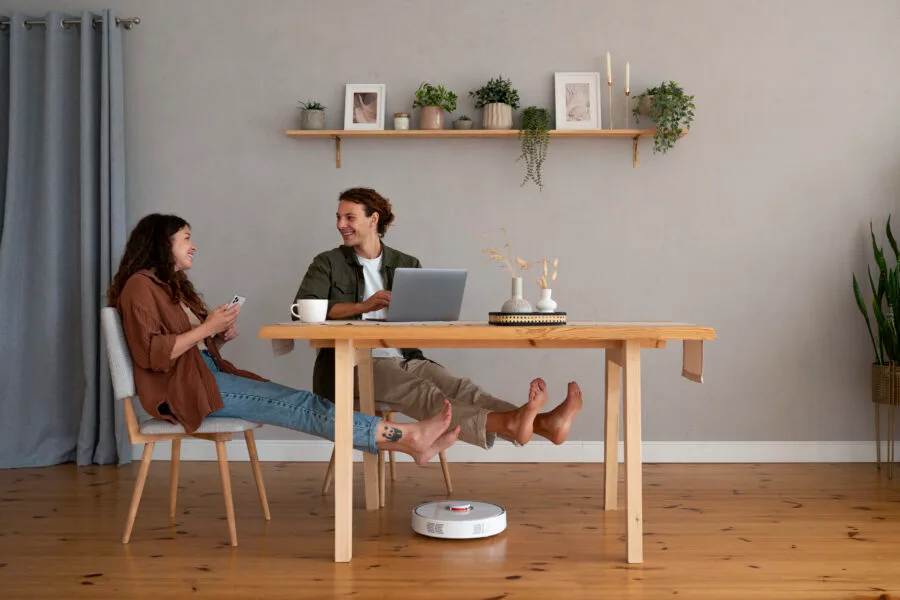
One of the best things about practicing English with AI is that the technology is both interactive and immersive. Unlike more traditional means of language learning, based on textbooks and memorization, engaging with AI allows users to practice speaking in real time.
Users are able to receive instant feedback, correct their speech, and experiment with new vocabulary in a relaxed and comfortable space. Not only does this make the user more confident, but it also leads to an overall better understanding of the language.
Through the use of the power of AI, students are able to make impressive gains in language abilities without the tedium of the process.
II. English Practice with Smart Speakers
Smart speakers are now a standard feature in many homes, changing the nature of talking to technology and offering a special platform for practicing English. These smart speakers based on AI use advanced voice recognition technology to offer a number of interesting ways to improve your language abilities.
Below are some fun and practical smart speaker practice methods to try.
A. Entertainment and Music Voice Commands
One of the simplest and most enjoyable ways of practicing English with smart speakers is through entertainment and music. You can instruct your device to play your favorite music, and as you play along, try to sing along to work on your pronunciation and rhythm.
Additionally, listen to different artists or types of music by providing voice commands like “Play jazz” or “Play 80s music.” Reading lyrics can help improve your vocabulary too; you might attempt discovering the meaning of unknown words or phrases that you hear in the songs.
B. Asking Questions to Build Vocabulary and Understanding
Smart speakers have AI assistants which can give responses to a huge range of questions. This feature can be an excellent means of practicing English. Start with simple questions, e.g., “What is the weather like today?” or “What is the capital of France?” And as you build your confidence, you can make use of more challenging questions.
For instance, you can ask your computer for explanations of idioms or phrases that you encounter while reading.
This not only enhances your vocabulary but also your comprehension skills as you become accustomed to picking up from usage and context.
This engaging approach makes learning less tense and more fun, and you can practice speaking in a relaxed environment.
C. Setting Reminders and Timers to Practice Command Structures
Another effective way of using your smart speaker is through setting reminders and timers on it. This conversation keeps you in check while also providing you with an opportunity to practice specific command structures.
For example, you might say, “Set a reminder for 3 PM to practice English,” or “Set a timer for 10 minutes to study vocabulary.” These commands force you to form complete sentences, which serve to further solidify your understanding of English grammar and syntax.
You can also set the routine that involves constant practice of speaking. For instance, create a morning routine where you ask your smart speaker to provide you with the news, weather, and motivational quotes. Not only will this daily routine develop in you the habit of speaking English, but you will also be up-to-date and inspired. By incorporating these small but continuous interactions into your daily routine, you will find that your fluency and confidence in English will improve naturally over time.
III. Interaction with Smart Home Appliances
As technology improves, smart home appliances are now an everyday occurrence and not only offer convenience but also a fascinating means of using English in a real situation. Interaction with them can enhance your language ability while learning subconsciously becomes an integral part of your lifestyle.
Some of the entertaining ways to use smart home technology to improve your English speaking.
A. Voice Command for Lighting and Temperature
Practicing your English is one of the simplest ways by using voice commands for lighting and temperature at home.
Most smart assistants will obey commands like “Turn on the living room lights” or “Set the thermostat at 72 degrees.” Repeat these sentences and continue your learning with imperative sentences as well as pronunciation practice.
Experiment with changes, like “Dim the lights” or “Adjust the temperature,” to master more vocabulary as well as becoming familiar with different command structures.
B. Operating Smart Appliances for Cooking Commands
Smart kitchen appliances such as ovens, refrigerators, and kitchen helpers can be excellent tools for language practice. Any smart device you use has voice control that you can utilize in the kitchen. You can, for instance, tell it, “Preheat the oven to 350 degrees” or “Add two tablespoons of olive oil into the recipe.” These dialogues are an excellent and practical means to study food-related terms and cooking terms.
C. Building Routines to Support Daily Conversation Skills
Habit formation with your home automation devices can also build language skills. You can try to form a morning habit where you interact with your device to check the weather, view your calendar, and listen to the news. You can start the day by uttering statements like, “What is the weather today?” or “What is on my calendar?” This habit makes you more fluent and helps you to think critically and respond to questions.
By actually engaging with intelligent home appliances, you can turn everyday tasks into great English practice opportunities. It not only helps enhance your language skills, but it also enables you to become more comfortable and confident with using English in various contexts.
IV. Uncovering Language Learning Apps
As technology continues to advance, so do the language learning devices. Merging language learning apps and intelligent devices can significantly enhance your practice in English language so that it is a more immersive and realistic experience.
A. Merging Language Apps and Intelligent Devices for Practice
All the major language learning programs, such as Promova, Babbel, and Rosetta Stone, can be easily accessed on smart devices like tablets, smartphones, and even smart speakers. By linking these applications to your devices, you can enjoy a seamless setup to practice.
You can, for instance, have your smart speaker launch your favorite language app to allow you to start a lesson without navigating through the menu.
This hands-free approach not only saves time but also gets you used to practicing verbalization, so your pronunciation and fluency improve.
B. Practice Chats with AI Chatbots
AI chatbots are good language learning tools which provide real-time conversational practice. Language learning apps mostly use chatbots that engage in conversation and let you talk at your own speed. You can enhance your speech by responding to questions, asking your questions, and receiving instant feedback. This makes you feel more confident when using spontaneous speech because the AI of the chatbot learns based on your level and gives word suggestions or corrections.
C. Tracking Progress and Goal Setting
One of the best advantages of language learning apps is that you can track your progress and set achievable goals. Most apps have analytics preinstalled that monitor your learning process, so you can see how many hours you have practiced, how many lessons you have completed, and where you need to improve. You can set daily or weekly targets, like the completion of a specific number of exercises or memorizing a specific number of new words.
By linking your language app to your smart devices, you can be reminded by your smart speaker and remain on track and motivated.
For example, you can just say, “Hey Google, remind me to practice English with Duolingo every evening at 7 PM,” so it is easier to incorporate language practice into your habit.
V. Conclusion: The Future of Language Learning at Home
Interacting with AI in our daily lives offers a new and fascinating experience to practice English. Benefits of practicing with smart devices extend well beyond mere convenience; they offer an interactive environment that fosters language acquisition in a natural environment.
In summation, embracing the potential of AI in our homes is a solid step towards learning a foreign language. We welcome you to explore and experiment with the smart technology available at your fingertips. The future of learning languages in our homes is bright, and it’s time to start talking to your home!